

Racial Discrimination in the Workplace: A 2026 Guide
Home • Racial Discrimination in the Workplace: A 2026 Guide
Race discrimination in the workplace occurs when employers or coworkers treat an employee or applicant unfairly because of their race. This type of conduct can appear in hiring decisions, pay practices, promotions, job assignments, or interpersonal interactions.
Federal law prohibits racial discrimination at work, but it continues to affect workers throughout the United States. Understanding your rights and knowing how to address discriminatory behavior can help you take informed steps to protect yourself from unfair treatment.
Table of Contents
- Understanding Racial Discrimination at Work
- How the Law Protects Workers From Racial Discrimination
- Signs of Racial Discrimination at Work
- What To Do if You Experience Racial Discrimination in the Workplace
- Protection Against Retaliation in the Workplace
- Employer Responsibilities for Preventing Workplace Race Discrimination
- Legal Remedies for Victims of Racial Discrimination
- When To Contact a Workplace Discrimination Lawyer
- You Don’t Have To Accept Workplace Discrimination
Understanding Racial Discrimination at Work
Workplace racial discrimination refers to actions that harm employees or job applicants because they are of a certain race or have physical characteristics associated with that race. This discrimination can be direct or indirect or involve harassment.
Direct discrimination occurs when an employer intentionally treats someone differently because of their race. Indirect discrimination involves workplace policies or practices that technically apply to everyone but end up disproportionately affecting specific racial groups. Harassment occurs when conduct targeting a person’s race creates an intimidating or hostile work environment.
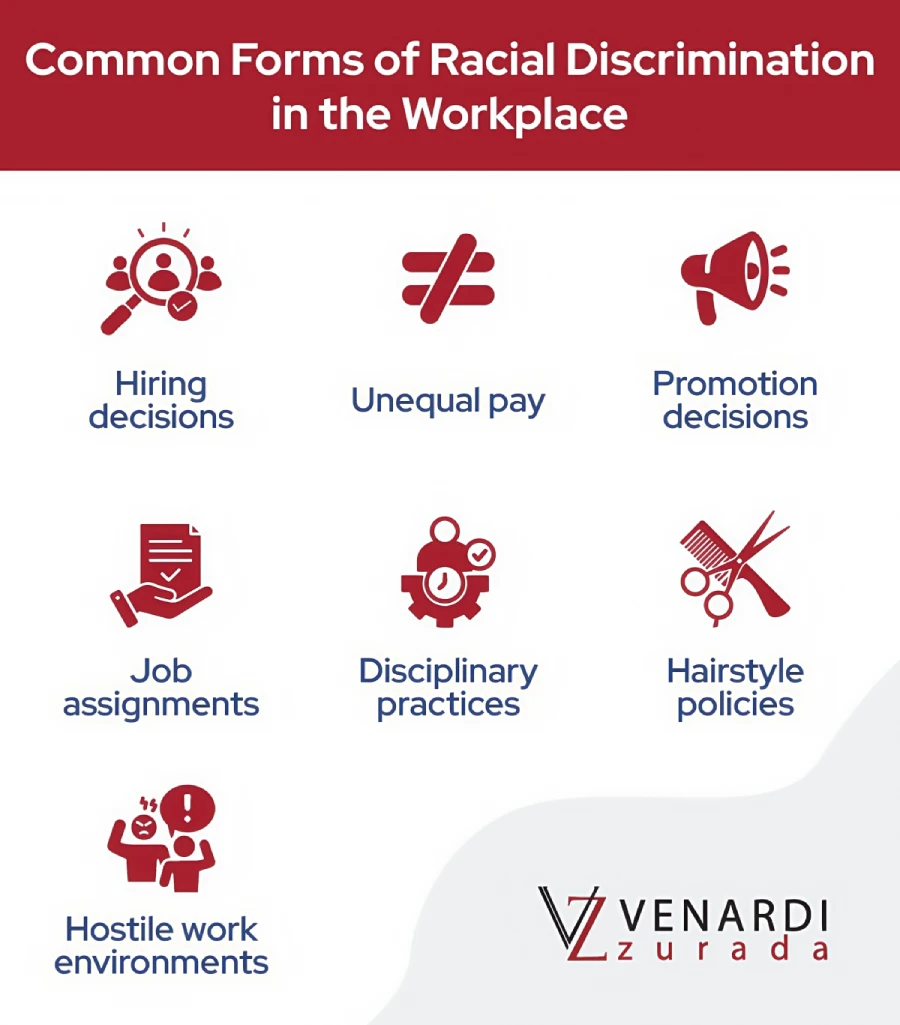
Common Forms of Racial Discrimination in the Workplace
Race and color discrimination can appear in various aspects of employment. These examples show the many different ways it commonly affects workers:
- Hiring decisions: An employer may reject qualified job applicants solely because of their race.
- Unequal pay: An employer may pay employees of certain races less than others, even when they perform the same work. They may also offer unequal bonuses or benefits based on employees’ racial backgrounds.
- Promotion decisions: A manager may repeatedly pass over qualified employees of a specific race for promotions.
- Job assignments: An employer may assign employees of a particular race a heavier workload or less desirable tasks.
- Disciplinary practices: A supervisor may discipline employees of certain racial groups more harshly than others for the same conduct.
- Hairstyle policies: An employer may enforce grooming rules that prohibit hairstyles associated with certain races, such as braids, locs, or afros.
- Hostile work environments: Coworkers or supervisors may make racially offensive comments or act aggressively toward an employee because of their race.
How the Law Protects Workers From Racial Discrimination
Title VII of the Civil Rights Act of 1964 is the primary federal law prohibiting race-based employment discrimination. Under this law, it’s illegal for employers to refuse to hire someone, terminate them, pay them differently, alter their job conditions, harass them, or offer different job opportunities because of their protected status.
This law specifically protects workers from discrimination based on race, color, and national origin, which are closely related but distinct categories. Race generally refers to a person’s broader racial characteristics, while color specifically refers to the lightness or darkness of a person’s skin. National origin discrimination involves unfair treatment because of the part of the world an employee is from, their accent, or their perceived ethnic background.
Title VII applies only to employers with 15 or more employees, so employees of small businesses may not have those protections. However, state and local laws may fill in the gap. For example, California’s Fair Employment and Housing Act generally prohibits racial discrimination by employers with five or more employees.
Signs of Racial Discrimination at Work
In many workplaces, racial discrimination shows up through subtle patterns of unequal treatment or outcomes for employees of different races.
For instance, you may notice that opportunities are unevenly distributed among employees. Employees of one race might consistently hold leadership positions, while employees of another race remain largely in lower-level roles despite having the qualifications for advancement. Your employer may also repeatedly decline to hire qualified applicants from certain racial backgrounds after interviews.
Pay disparities are another warning sign. Employees of one race may earn less than coworkers performing similar work or receive fewer raises or bonuses. These differences may become apparent in casual workplace conversations, such as when a colleague expresses frustration about being underpaid.
Harassment is often the most obvious red flag. Supervisors may act in a friendly manner toward employees of one race while frequently disparaging those of another race. They might also tolerate offensive race-based comments that create a hostile work environment for employees of certain backgrounds.
What Workplace Race Discrimination Could Look Like
Marcus has worked at his company for several years and regularly receives strong performance reviews. When new leadership positions open, he applies but is passed over each time in favor of less experienced coworkers from a different racial background. Over time, Marcus notices that nearly all management roles in his department are held by employees of the same race.
In another workplace, Aisha and her coworker Mike perform the same job with similar responsibilities. During a casual conversation, Aisha mentions struggling financially because her pay has barely increased in years. Mike is surprised and reveals that he’s received several large raises and earns over $30,000 more per year than Aisha. As Aisha begins asking other coworkers who share Mike’s racial background, she realizes that their salaries are all significantly higher than hers.
What To Do if You Experience Racial Discrimination in the Workplace
Document the Discrimination
Start by documenting what is happening. Write down dates, locations, and the details of the mistreatment. Save all records that might show a pattern of unequal treatment, such as emails or performance reviews.
Notify Your Employer
It’s also a good idea to report the behavior to your employer. Review your employer’s policies and follow any outlined procedures for reporting discrimination concerns through human resources or a designated supervisor.
Be sure to submit the complaint in writing. Explain the situation clearly and provide any supporting documentation you’ve gathered.
File an EEOC Report
If your employer fails to resolve the issue promptly, consider filing a complaint with the U.S. Equal Employment Opportunity Commission (EEOC). This allows the EEOC to review the complaint and determine whether to investigate. Your employer may face disciplinary action if an investigation supports your claim, which may discourage further discrimination.
You can use the EEOC Public Portal to file a discrimination complaint online. You may make a formal complaint with a state or local agency, and the agency will automatically file it with the EEOC if federal laws apply to your situation.
Protection Against Retaliation in the Workplace
Retaliation occurs when an employer takes negative action against an employee because they reported discrimination. Retaliatory actions may include termination, demotion, a reduction in an employee’s hours, or a hostile work environment that makes it difficult for the employee to continue working.
Title VII of the Civil Rights Act of 1964 prohibits retaliation against workers who assert their right to work in an environment free from unlawful employee discrimination and harassment. That means your employer cannot punish you for speaking up about racial discrimination or complying with an investigation.
If you’re concerned that your employer might retaliate against you, you can protect yourself by documenting your discrimination concerns and keeping records of any complaints you make. If negative actions begin after you report discrimination, hold on to any relevant evidence, such as written notices from your employer. This creates a clear timeline of events that can demonstrate a connection between your complaint and your employer’s response.
Employer Responsibilities for Preventing Workplace Race Discrimination
Employers play a critical role in preventing racial discrimination in the workplace. Equitable workplaces often implement diversity, equity, and inclusion, or DEI, initiatives to establish standards for fair treatment across the organization.
These efforts may include policies outlining expectations for respectful conduct and training programs that help employees recognize and address discriminatory behavior. Employers can also reduce potential hiring biases by using standardized evaluation criteria and anonymous resume reviews that remove identifying details, such as names, while screening candidates.
Reporting Procedures and Corrective Action
Companies should also outline clear procedures for reporting discrimination concerns and make the process accessible and confidential. When an employee reports an issue, HR should respond quickly and conduct a fair investigation.
If they find evidence of discrimination, they must take appropriate corrective action. This could include providing additional training or terminating the employee responsible for the misconduct.
Legal Remedies for Victims of Racial Discrimination
You may have legal options after experiencing racial discrimination at work. If an investigation shows that discrimination occurred, several remedies may be available depending on the circumstances.
One possible remedy is financial compensation. This may include payment for lost wages, missed bonuses, or other earnings you would have received if the discrimination hadn’t occurred. In some cases, you may also recover damages for emotional distress you suffered because of the mistreatment.
Legal action may also focus on restoring lost opportunities. For example, a settlement may require your employer to reinstate you to your previous position if you were wrongfully terminated or provide a promotion that they unfairly denied.
When To Contact a Workplace Discrimination Lawyer
In some situations, you may want to consider speaking with an employment lawyer about your concerns regarding racial discrimination. Legal guidance can be especially important if your employer doesn’t respond appropriately to your complaints or if you’ve suffered significant financial losses because of the way you’ve been treated.
An experienced attorney can help you understand if your employer has violated any anti-discrimination laws and determine if you qualify to pursue legal action. They can help you file a formal complaint with the EEOC and potentially file a lawsuit against your employer.
Before you consult an attorney, it can be helpful to gather any documentation related to the situation. This may include emails, written complaints, performance reviews, or pay records.
Having this information ready can help the lawyer evaluate your case more efficiently, but don’t stress if you’re missing anything. They can identify what additional evidence might help you prove race discrimination and obtain records that may be difficult for you to access on your own.
You Don’t Have To Accept Workplace Discrimination
Race discrimination at work can affect every aspect of a person’s career, from hiring and pay to promotion opportunities and daily working conditions. These effects can extend into an individual’s personal life, causing mental health problems and impacting their financial well-being. Race-based discrimination is never okay, and you have the right to fight back when it occurs.
If you’ve experienced racial discrimination in the workplace, taking action can help you protect your rights, hold your employer accountable, and prevent others from suffering similar mistreatment. While discriminatory behaviors aim to make you feel powerless, you can make a meaningful difference by speaking up and seeking support when needed.

Legally Reviewed By:
Mark Venardi
Partner
- Posted on